
Here are quick diagram and review on the 4 quadrant approach to fluid responsiveness and fluid tolerance with the Diamond-Forrester Profile as we learned the basics with flosonic’s flopatch and Dr. Haycock’s lecture on VExUS. These tools are an incredible window to understanding the dynamic resuscitative process and careful fluid management with our critically ill patient.
case study:
patient 1: Came in with a chief complaint of abdominal pain. Vital sign: Tmax 101, HR 134 regular, 02 92% RA, BP 87/35, NP-POCUS: collapsible IVC >50%, hyperdynamic heart, A-line on lung fields. Hemodynamics: SV 45, responsive to PLR assessment, SVR 650. Initial intervention of 1L LR with results as follow; SV 62. SVR 680; VS: HR 110, BP 90/45. POCUS IVC <50% collapsible, delta SV <10% change.
patient 2: Pt came in with CAP. VS: Tmax 100.8, HR 110, afib, 02 87%, BP 85/45, NP-POCUS revealed dilated IVC, hypodynamic heart, B-lines bilaterally to lower bases. Hemodynamics: SV 40, unresponsive PLR assessment, SVR 560. Pt responded to low dose epi gtt at 4 mcg/min. VS: HR 90, placed on 4L 02 saturating at 94%, BP 102/56 mmHg. A timely borad spectrum antibiotic was infused within 1 hour of resuscitation time.

Diamond-Forrester Profile: Profile 1 healthy state, “warm-dry” normal cardiac index, low filling pressure. Profile 2 signs of venous congestion, VExUS 2 or 3, “warm-wet” Diamond–Forrester profile. first-line norepinephrine. a fluid-unresponsive patient in profile 2 will better tolerate decongestion than a fluid-responsive one. With diuresis, reducing congestion until FR re-emerges could predict successful liberation from mechanical ventilation. Profile 3 A low LVOT VTI without venous congestion, VExUS 0 or 1e “cold-dry”. septic venodilation coupled with acute diastolic dysfunction. Unresponsiveness in this quadrant early in sepsis might benefit from prompt vasoactive infusions (e.g., norepinephrine) and time for antibiotics to ease inflammatory response. Profile 4 venous congestion and low LVOT VTI and corresponds to the “cold-wet” profile. likely to have primary pump dysfunction.
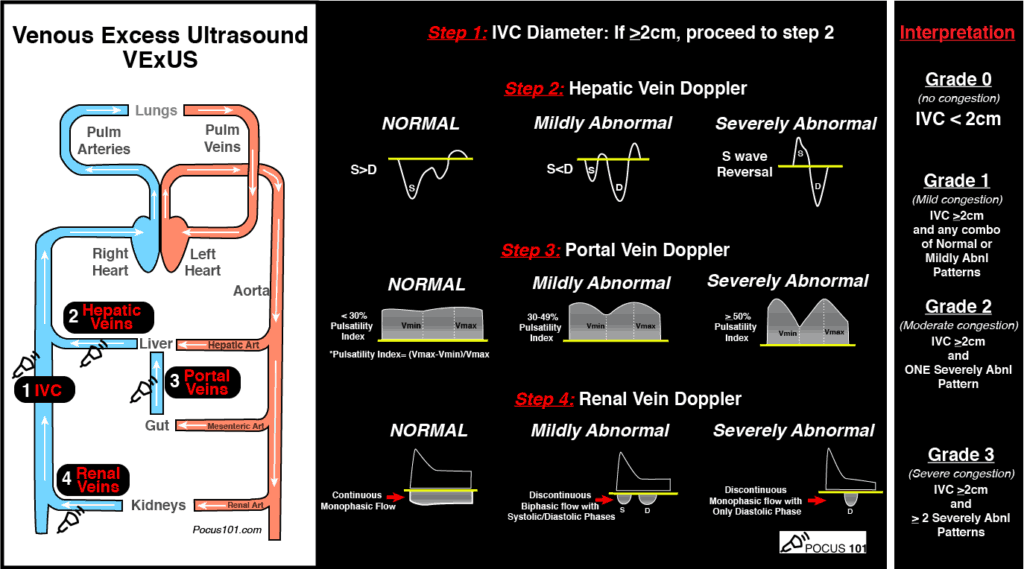
VexUS score (the Venous Excess Ultrasound (VExUS) Score, an exam that evaluates and scores the severity of venous congestion of not just the IVC but also the liver, gut, and kidneys.

Unifying fluid responsiveness and tolerance with flosonic and wearable flopatch. Read on to | Changes in venous Doppler morphology with a wireless ultrasound patch
Names, dates, and personal identifying details have been changed throughout this website to comply with the Health Insurance Portability and Accountability Act (HIPAA). ** | This website runs on coffee. Thank you for supporting this journey!
 Code Team Pearls
Leave a comment