
Sudden cardiac arrest is a leading cause of death in industrialized nations, with over 700,000 annual fatalities in Europe and the USA, largely due to ventricular fibrillation (VF) or pulseless ventricular tachycardia. Despite repeated defibrillation attempts, many patients remain in shock refractory VF, and further attempts without method changes are often ineffective, leading to decreased survival rates. Various treatments for shock refractory VF have been suggested, including vector change defibrillation, which alters the positioning of defibrillation pads, and double sequential external defibrillation (DSED), which utilizes two defibrillators for delivering shocks in different pad placements.
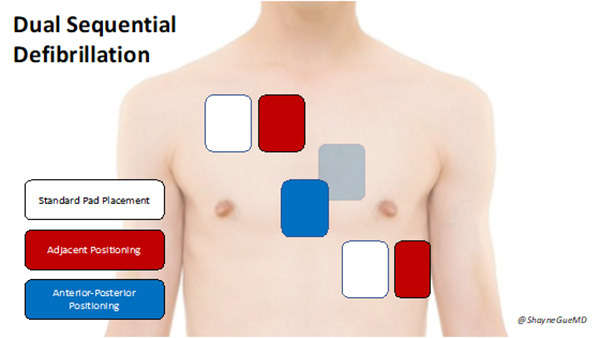
Created by Shayne Gue, MD, MSMEd | Standard Placement: The first set of pads (white) is placed in the anterior-lateral (AL) position, with one pad on the upper right chest and the other on the lower left chest. Second Set Placement (Alternate): The second set can be placed in two ways: Anterior-posterior (AP) placement (blue) involves placing one pad on the sternum and the other on the back, while the second set anterior-lateral (red) involves placing the pads next to the first AL pads, ensuring they do not touch.
Important Considerations:
- Avoid Contact: Make sure the pads from both defibrillators do not touch. Contact can damage the devices.
- Sequential Shocks: Administer the shocks from the two defibrillators one after the other, with a brief delay (<1 second) in between. This reduces the risk of damaging the devices if the shocks are given at the same time.
- Coordination: DSED needs teamwork from the healthcare team, using two defibrillators and careful pad placement.
- Refractory VF: DSED is mainly used for refractory VF that doesn’t respond to standard defibrillation.
- AHA Recommendations: The American Heart Association (AHA) does not recommend regular use of DSED for refractory shockable rhythms, but it may be considered in challenging cases.
In summary, dual sequential defibrillation involves using two defibrillators with pads placed in standard anterior-lateral and either anterior-posterior or another anterior-lateral position, ensuring safety and preventing pad contact.
Names, dates, and personal identifying details have been changed throughout this website to comply with the Health Insurance Portability and Accountability Act (HIPAA). **
 Code Team Pearls
Leave a comment